.svg)





.png)

Quick question. No Googling.
When you hear the word "energy drink," what comes to mind?
Red Bull. Almost immediately. You didn't need to think about it. You didn't weigh your options, assess the category landscape, or run a feature comparison. The answer appeared before the question was finished.
Now try this: what's the second energy drink you thought of? That one took longer. And the third? You actually had to work for it.
That gap (between instant recall and effortful memory) is what brand positioning is about. And the gap between being #1 and being #2 in your customer's mind isn't just symbolic. Consistently, across categories, the perceived #1 player commands roughly twice the market share of the #2. The #2 commands roughly four times more than the #3.
Try it right now. Think of a 10-minute grocery delivery app. Blinkit: instant. Now think of the second one. Zepto, maybe, took a beat longer. Now the third? You actually had to stop and search your memory. That hesitation, that friction in recall, is what it looks like to not be positioned at the top of someone's ladder. Blinkit didn't get there by having the fastest delivery. It got there by claiming the category clearly and early, before the customer's mind had filed anyone else in that slot.
Most of the brands you love, pay a premium for, and stay loyal to despite better options don't have the best product in their category. They have the best position.
This is the most important concept in building a brand, and the most misunderstood. Let's fix that.
The world changed. Most marketing advice didn't.
We are living through what might be the noisiest communication environment in human history.
The average Indian spends over two and a half hours per day on social media. That's 17 hours a week. More than 900 hours a year. Over a full month of your life, every year, spent scrolling. And in every one of those scrolls, you're passing through hundreds of brand names, logos, messages, and advertisements, most of which register and vanish in milliseconds.
Across all media (television, digital, outdoor, radio, print), over ₹4 lakh crore was spent on advertising in India in 2024 alone. That's ₹4 lakh crore competing for the same resource: your attention.
In that environment, having a good product is necessary. It's not sufficient.
Here's the line that most founders, marketers, and business leaders have heard and quietly disagreed with at some point: "As long as the product is good and the plan is sound, it will sell."
Partly true. In a market with no competition, where your product is the only answer to a problem, quality is enough. First-time purchases are often about the product. But we don't live in that market. Every idea you can think of has an existing alternative. Every problem you're solving has a workaround your customer is already using. And the moment there's a choice, the product stops being the only variable, and the story you tell about the product becomes critical.

Tata Nano was an extraordinary piece of engineering. One lakh rupees. A small, safe, practical car designed to get Indian families off two-wheelers and into a vehicle built for four. The product vision was remarkable.
The positioning destroyed it.
Clubhouse had viral growth during a global pandemic. Pepsi Blue existed. Frooti relaunched with nostalgia and an ambassador. Pepper Fry is a real company. Most people can't clearly say what any of these stand for, which category they lead, or why anyone would specifically choose them.
Good products. Unclear positions.
We've moved through three eras. Most companies are still in the second.
To understand where positioning fits, it helps to understand how we got here.
Era 1: The Product Era
When the telephone was invented, it sold. When the refrigerator arrived, it sold. When the car appeared, it sold. Not because of brilliant marketing. Because there was nothing else like it. If you had something genuinely new, the product sold itself. The first purchase was an act of curiosity, not preference.
Era 2: The Branding Era
As competition entered every category and product quality became standardized, companies began building brand value on top of product value. Nike vs. Adidas. Coke vs. Pepsi. The product is more or less the same; the brand creates the preference. This era is where most marketing still operates: logos, campaigns, brand guidelines, visual identity.
The problem: branding era thinking is now as crowded as the product era was before it. Every company has a brand. Every company has a story. Every company has a purpose statement. In a world where everyone has a brand, having a brand is no longer differentiating.
Era 3: The Positioning Era
This is where we are now. And the companies winning here (Tesla, Apple, Red Bull, Volvo, Spotify, Patanjali in its specific lane) have done something different from both eras before. They haven't just built products or brands. They've claimed specific mental territory. They've made deliberate decisions about which category they want to own, which corner of the customer's mind they want to occupy, and then they've organized everything
That deliberate act of mental territory-claiming is positioning.
What positioning actually means
Here is the clearest definition:
Positioning is the process of identifying who you should be in the mind of your customer, and then creating an organized system to own that space.
Note what it doesn't say. It doesn't say positioning is about your product features. It doesn't say it's about your mission statement. It doesn't say it's about what your CEO believes or what award you won or what your NPS score is.
It's about the mind of the prospect. Specifically, it's about which mental bucket your customer files you under, and whether you're at the top of that bucket or somewhere in the middle.
Positioning is not what you do to the product. It is what you do to the mind of the prospect.
The product can remain exactly the same. A repositioning can change everything. Red Bull didn't reformulate its drink when it went from Thai tonic to global phenomenon. The product was essentially the same caffeinated formula. What changed was the story told about who it was for, and that story created an entirely new category.
The mental filing cabinet
Your customer's mind isn't a blank canvas waiting to receive your message. It's a fully organized filing system, built up over decades of experience, culture, observation, and memory.
In that filing system, there are categories. And in every category, there's a ladder: #1, #2, #3. The #1 slot is where a brand lives when the customer reaches for that category without needing to think. The #2 slot is where they go when the #1 isn't available. The #3 slot requires actual effort to recall.
Biscuits are a category. But biscuits contains multiple subcategories: everyday value (Parle-G), premium indulgence (Good Day with cashews), health and wellness (Marie Gold), kids delight (Hide & Seek). The product is more or less the same biscuit. But your mind doesn't file them together. It files them separately, by use case, by occasion, by mood. And for each subcategory, there's a different #1.

Coffee is a category. But coffee contains: quick energy (roadside tapri), authentic filter coffee, café experience (Starbucks, Blue Tokai), and specialty single-origin. When you decide "I need a coffee," your mind is already doing a subcategory sort, based on your mood, your company, your time, your bank balance at that point in the month.
This is the secret of positioning: the more precisely you define which subcategory you want to lead, the more clearly you can communicate to exactly the right customer in exactly the right moment.
The brands that try to appeal to every subcategory at once end up owning none of them. The brands that pick one subcategory, claim it clearly, and defend it consistently end up becoming the word for that entire space.
Being first in the market vs. being first in the mind
Here's the most dangerous myth in brand strategy: going to market first means winning the market.
Was Red Bull the first caffeinated drink? No. Was Tesla the first electric car? No. There were EVs on American roads before 1910. Was Google the first search engine? No. Yahoo, AltaVista, Lycos, and others came before it. Was the iPhone the first touchscreen smartphone? No.
None of these brands created their category in the literal sense. They claimed their category in the most important place: the mind.
Going first to market gives you an advantage. It does not guarantee mindshare. And mindshare, not market share, is what you're actually competing for, because market share follows mindshare with a lag.
Jio understood this. When Reliance Jio launched in 2016, they didn't position themselves as "a better telecom." Airtel, Vodafone, and Idea had been competing on network quality, coverage, and plan pricing for years. Jio didn't enter that comparison at all. Instead, they made their enemy the entire premise of expensive, limited data: the idea that internet access was a luxury you rationed. They didn't say "our data plans are cheaper." They said "data is your right" and gave it away free for months.
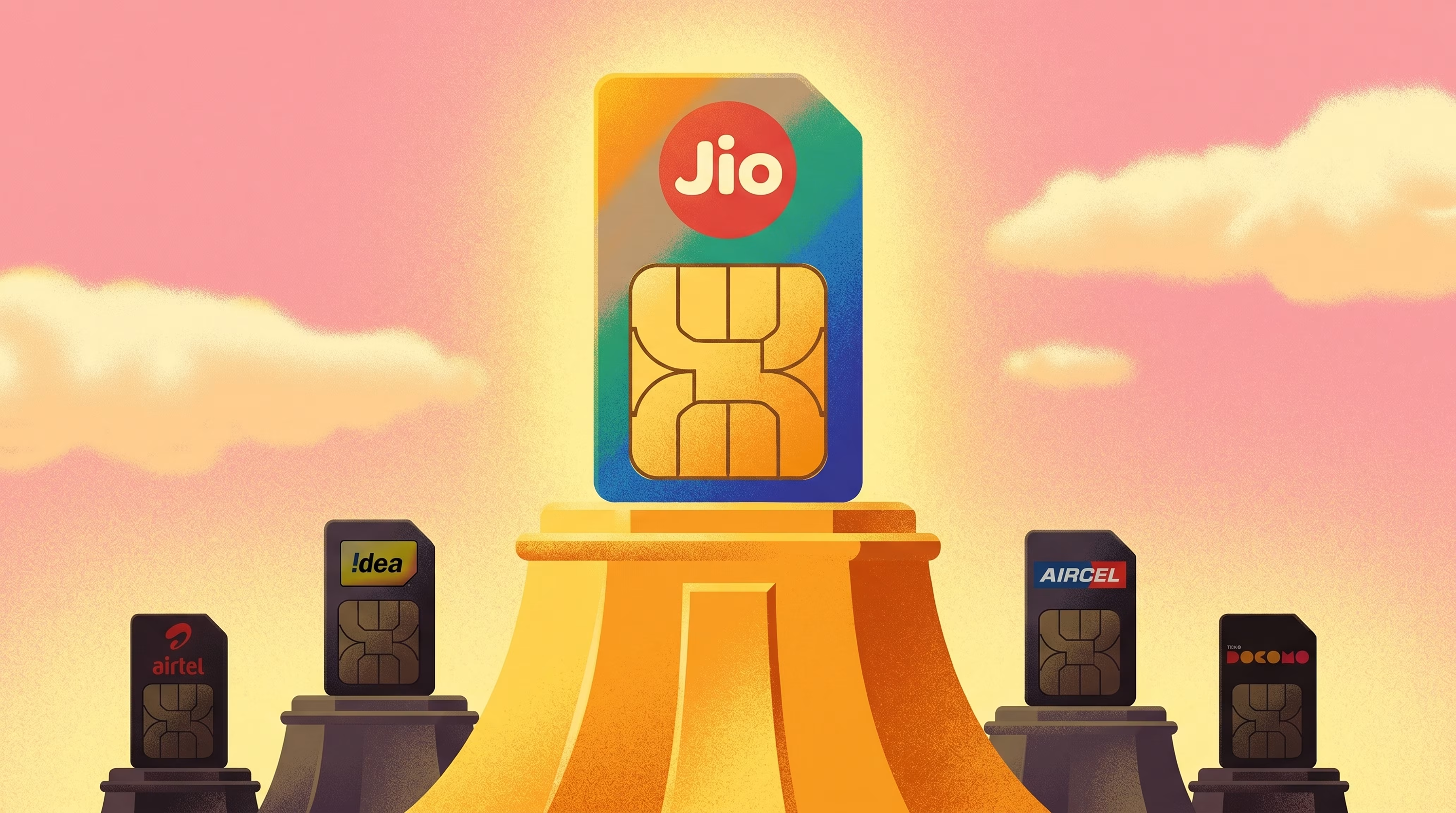
By reframing the competition that way, Jio didn't enter the telecom category. It redefined it. Within a year, every competitor was forced to drop prices, revamp plans, and reposition themselves in response to Jio's terms. That's what happens when you claim a category on your own terms: the competitors are left validating the category you already own.
That's the difference between being first and being first in the mind.
Want to go deeper on this? Stop Being Forgettable is a 6-hour masterclass on brand positioning, covering how the mind processes brands, how to build a full positioning strategy, and how to apply it across your organisation. Built for founders, CMOs, and brand leaders at every stage. Explore the course →
What positioning is not (common confusions worth clearing up)
Positioning is not your tagline.
A tagline can express your positioning, but it's not the positioning itself. "Just Do It" is an expression of Nike's position (performance, willpower, action). The position came first. The tagline followed.
Positioning is not your logo.
Your logo is identity: a visual shorthand for the position you've established. Designing a logo before your positioning is settled is like making a sign before you've decided what your business does.
Positioning is not a marketing campaign.
Campaigns communicate positioning. They don't create it. Running a campaign without clear positioning is like trying to drive to a destination without knowing the address. You'll spend the budget. You won't arrive.
Positioning is not about being the best.
"We're the best" is not a position. It's a claim. Every competitor makes the same claim. A position is specific: best for whom, in which category, against which alternative, with what proof. Volvo doesn't say they're the best car. They say they're the safest. That specificity is what makes it a real position, and what makes it ownable.
(For a full breakdown of how positioning, identity, and strategy differ, read: Brand positioning vs. brand identity vs. brand strategy)
How the mind decides: the window metaphor
When you're trying to claim a position, you're not inventing space in someone's mind. You're finding a window that already exists (an unrealized need, an unclaimed category, an existing belief that nobody has attached a brand to yet) and opening it.
When CRED launched in 2018, they didn't say "we're a bill payment app." Apps for paying credit card bills already existed. Instead, they found a window sitting open in the minds of a specific kind of customer: creditworthy Indians who quietly took pride in their financial discipline but had no brand recognising it. CRED didn't give them a utility. They gave them a club. "Pay your bills here, if your credit score qualifies." Familiar (rewards for spending), interesting (you have to earn the right to join). Safe and new at the same time.
This is the golden rule of positioning a new product: take something familiar, add one clear difference, and make it interestingly safe. The familiarity creates trust. The difference creates attention. Together, they create a door your customer is willing to open.
Airbnb didn't say "peer-to-peer accommodation marketplace." They said: rent someone else's place instead of a hotel. Hotel is familiar. Renting is familiar. Someone else's place is the one interesting difference. That single formulation created an entire category.
Words create worlds
One of the most underappreciated lessons in brand positioning is this: the words you choose to describe your product don't just describe it. They place it in your customer's mind.
Tata Nano proved this at enormous cost.
The car itself was a genuine innovation: a safe, small, affordable vehicle that could end the dangerous practice of four people on a two-wheeler. The vision was clear. The engineering was sound. The price, one lakh rupees, was designed to be accessible to the families who needed it most.
But in a press conference, the word "cheapest" appeared. The media picked it up. "World's cheapest car" became the positioning, not by strategic choice, but by accident. And in Indian society, cheap and affordable may look like synonyms in a dictionary, but they activate entirely different worlds in the mind.
Affordable says: smart value for money. Cheap says: social signal I don't want associated with me.
The same product. Radically different perception. Catastrophic difference in outcome.
Contrast with Patanjali, which launched as an unknown brand in 2006 with no legacy, no distribution network, no advertising budget comparable to FMCG giants. The category Patanjali claimed (Ayurvedic personal care products) had a competitor in Himalaya, but Himalaya had diversified away from it. The window was open.
Patanjali's words: natural, desi, Ayurveda. Every one of those carries cultural pride. Every one of those activates an existing belief system in their target audience. Not a single rupee spent on "affordable" as a message.
The result: a brand built from zero that became one of India's fastest-growing FMCG companies in under a decade.
Words create worlds. Choose them like the most important strategic decision you'll make. Because they are.
Why your position needs to be specific
There's a tendency among founders to resist specificity in positioning. "We don't want to limit our market." "We serve multiple segments." "We're unique in too many ways to define just one."
This is the instinct that creates brands nobody remembers.
The mind doesn't reward breadth. It rewards clarity. When your position is specific, the customer knows immediately whether you're for them. When it's broad, they have to do the work of figuring out if you're relevant, and most of them won't.

Think about it this way: there are thousands of biscuits in the market. But when you're packing a kid's lunchbox, you don't think about thousands of biscuits. You think about one. The brand that positioned itself most clearly for that specific moment (that specific use case, that specific parent, that specific need) gets the automatic purchase.
Specificity is not limitation. Specificity is precision. And precision is how you get to the top of someone's ladder.
(Wondering what this actually costs and how long it takes? Read: How long does branding take?)
(If you're navigating positioning yourself, the full framework (frameworks, examples, and process) is in Stop Being Forgettable →)
The one rule that changes everything
After everything we've covered, here's the distillation:
Being first in the mind of your customer in a specific category is more important than being first in the market, having the best product, or spending the most on marketing.
Everything else in brand strategy (identity, messaging, campaigns, activation) is in service of this one goal: to make sure that when your customer reaches for the category you've claimed, your name is the first one that comes to mind.
Not one of many options. Not "a good choice." The one.
That's what positioning does, when done with clarity and commitment.
Become™ is a Brand & Product Design Consultancy, headquartered in India and working with global brands including Fortune 500 companies. We work with growth-stage companies and IPO-ready businesses to build the positioning that drives revenue growth, market share, and category leadership. Start the conversation at become.team.
Or save this article as a PDF for future research, workshops and strategy sessions
.avif)
.avif)
.avif)






.svg)